
We’ve put together a page of quality, yet affordable consumable medical supplies. Click through and see if our research can lower your supply costs! https://mobileultrasound.co/medical-supplies/
chicago ultrasound Insight Echo
Mobile ultrasound information Insight Echo
High validity of cardiomyopathy diagnoses in western Sweden
High validity of cardiomyopathy diagnoses in western Sweden (1989-2009).
Abstract
AIM:
Hospital discharges with a diagnosis of cardiomyopathy have more than doubled in Sweden since 1987. We validated the cardiomyopathy diagnoses over this time period to investigate that the increase was real and not a result of improved recognition of the diagnosis and better diagnostic methods.
METHODS AND RESULTS:
Every fifth year from 1989 to 2009, records for all patients with a cardiomyopathy diagnosis were identified by searching the local registers in three hospitals in Västra Götaland, Sweden. The diagnoses were validated according to criteria defined by the European Society of Cardiology from 2008. The population comprised 611 cases with cardiomyopathy diagnoses [mean age 58.9 (SD 15.5) years, 68.2% male], divided into three major groups: dilated, hypertrophic, and other cardiomyopathies. Hypertrophic cardiomyopathy and hypertrophic obstructive cardiomyopathy were analysed as a group. Cardiomyopathies for which there were few cases, such as restrictive, arrhythmogenic right ventricular, left ventricular non-compaction, takotsubo, and peripartum cardiomyopathies, were analysed together and defined as ‘other cardiomyopathies’. Relevant co-morbidities were registered. The use of echocardiography was 99.7%, of which 94.6% was complete echocardiography reports. The accuracy rates of the diagnoses dilated cardiomyopathy, hypertrophic cardiomyopathy, and other cardiomyopathies were 85.5%, 87.5%, and 100%, respectively, with no differences between the three hospitals or years studied; nor did the prevalence of co-morbidities differ.
CONCLUSIONS:
The accuracy rate of the cardiomyopathy diagnoses from in-hospital records from >600 patients in western Sweden during a 20 year period was 86.6%, with no significant trend over time, strengthening epidemiological findings that this is likely due to an actual increase in cardiomyopathy diagnoses rather than changes in coding practices. The use of echocardiography was high, and there was no significant difference in co-morbidities during the study period. The accuracy rate of the cardiomyopathy diagnoses during the 20 year period was high. The use of diagnostic tools did not increase under the study period, and once cardiomyopathy diagnoses were suspected, echocardiography was performed in almost all cases. In this study, the occurrence of cardiomyopathy was increasing over time without significant increase of co-morbidity, supporting that an actual increase of cardiomyopathy has occurred.
© 2017 The Authors. ESC Heart Failure published by John Wiley & Sons Ltd on behalf of the European Society of Cardiology.
KEYWORDS:
Cardiomyopathy; Co-morbidity; Diagnosis; Validation
Goal Reversal? Study Suggests Echocardiography Could Have an Underuse Problem
Frequent use and wide availability of echocardiography (echo) have led to a belief that the test may be overused. Although echo is globally recognized as the most cost-effective, safe and portable tool for cardiac diagnosis, appropriate use criteria (AUC) and associated tools have been disseminated to help clinicians know when and when not to use echo. New data (J Am Coll Cardiol 2016;67[5]:502-11) now suggest that we should set our sights not on overuse of echo but rather on ensuring it is not underused.Upside down?The study that may have turned perceptions about echo utilization upside down was performed by Alexander Papolos, MD, and colleagues at Mt. Sinai Medical Center in New York City. They used the comprehensive National Inpatient Sample (NIS) database, which comprises 8 million annual hospitalizations representing 20 percent of community hospitals, to investigate national trends, practice patterns and patient outcomes associated with inpatient echo use from 2001 through 2011. They determined the admission diagnoses most commonly associated with echo use and then assessed whether echo use was associated with all-cause inpatient mortality. They found that the volume and incidence of performance of echocardiography has been increasing at a rate of about 3 percent per year over the past decade, but that echo is actually clinically underutilized for appropriate indications.Papolos and colleagues also identified an association between use of echocardiography and improved patient outcomes. They observed that patient mortality was substantially reduced in those with any of five critical diagnoses (acute myocardial infarction, cardiac arrhythmia, acute stroke, congestive heart failure or sepsis) who underwent echocardiographic examination during their hospitalization. Echo was associated with a 16 to 64 percent mortality risk reduction, yet it was used in only 8 percent of patients who had one of the five diagnoses, all of which have AUC backing their “appropriateness” for echo. The investigators concluded that claims of echo overutilization are unfounded and that the “cleansing light” of big data research suggests that echo is being underutilized and patients are suffering the consequences of excess mortality.The American Society of Echocardiography (ASE) has “echoed” this concern. ASE’s position is that it is critical to avoid procedures that are not beneficial to patients, such as those on its Choosing Wisely list (http://www.choosingwisely.org/societies/american-society-of-echocardiogr…); however, it is equally important to advocate for patients to receive procedures that are beneficial to their health and well-being.The study by Papolos and colleagues suggests that patients are not receiving guidelines-based diagnostic strategies using echo for optimization of treatment and long-term outcomes. Determination of left ventricular function before hospital dismissal is recommended for patients who experienced acute heart attack, stroke or heart failure in order to optimize medical, interventional and surgical therapies. The use of approved microbubble ultrasound contrast agents, if needed to enhance echocardiograms, also has been shown to further reduce inpatient mortality by 24 percent in a similar large hospital database (Premier) analysis (Am J Cardiol 2008;102[12]:1742-6).While both studies are limited by their retrospective and observational designs—meaning they cannot prove direct cause-and-effect—a Mayo Clinic real-time survey study found 95 percent of the echocardiograms performed for assessment of hospitalized patients during the study’s 20-week time frame in 2014 met AUC standards for appropriateness (Online J Am Soc Echocardiogr 2015 Dec 10). Moreover, when surveyed, the ordering physicians reported that the echocardiograms answered their clinical questions and thus were important in clinical decision making. The absence of radiation associated with echo technology makes it attractive, especially when repeated studies may be necessary and in young patients, as radiation dose is cumulative.Wake up & see value Partho Sengupta, MD, DM, who co-authored the NIS analysis, has said the study is a “wake-up call” and that the apparent underutilization of echo must be recognized. Echo is a relatively low-cost, safe, portable, effective, non-ionizing technology whose economic and safety impact has been undervalued.
Source: Goal Reversal? Study Suggests Echocardiography Could Have an Underuse Problem
Ultrasound Technician Opening
We have an upcoming opening for a general and vascular ultrasound technician. Please inquire if interested or pass it on. Thank you!
The impact of obesity on left ventricular mass and geometry. The Framingham Heart Study. – PubMed – NCBI
JAMA. 1991 Jul 10;266(2):231-6. Research Support, U.S. Gov’t, P.H.S.
Correlates of Echocardiographic Indices of Cardiac Remodeling Over the Adult Life Course
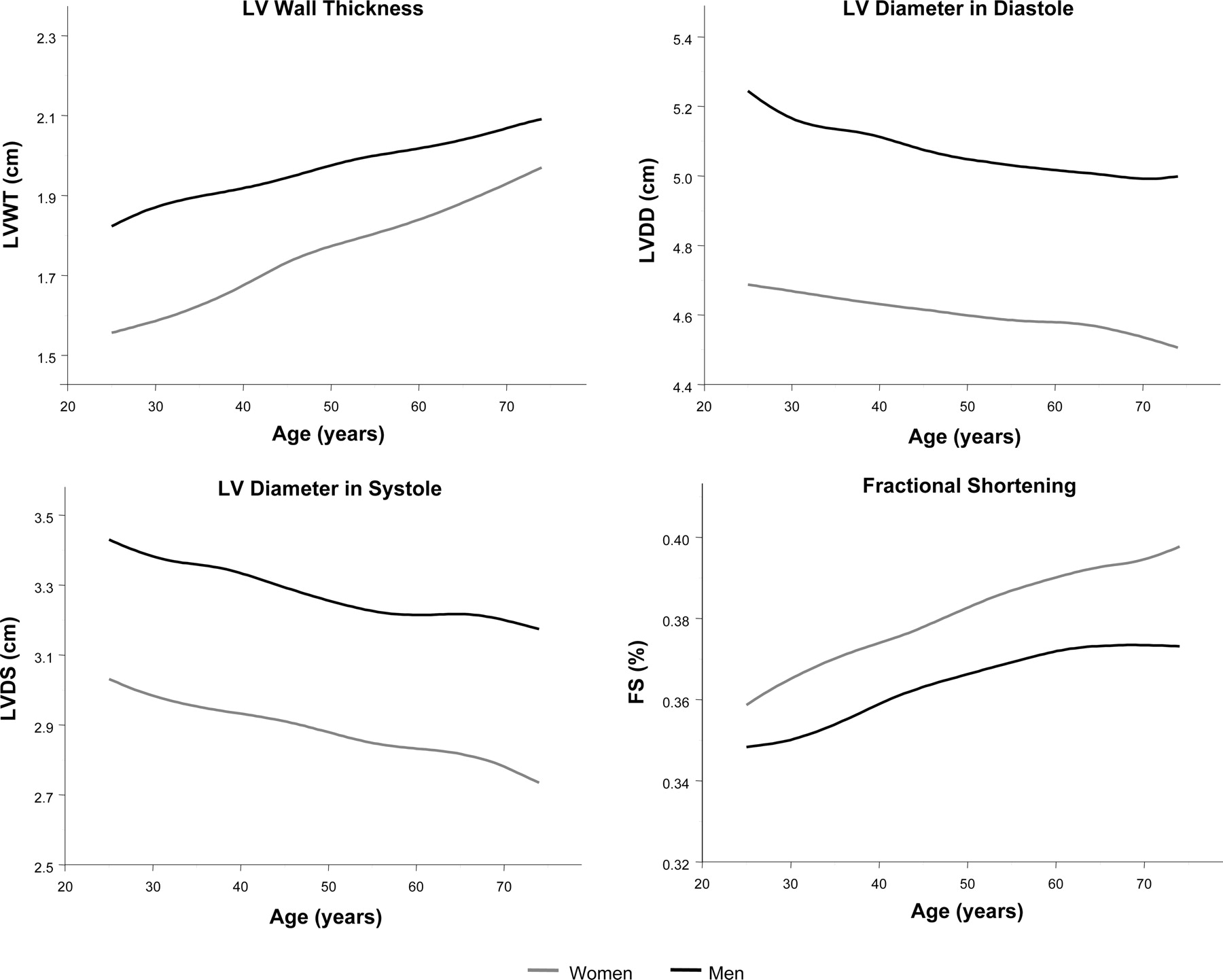
Correlates of Echocardiographic Indices of Cardiac Remodeling Over the Adult Life Course
Source: Correlates of Echocardiographic Indices of Cardiac Remodeling Over the Adult Life Course
 Source:
  Chicago's Mobile Ultrasound and Echo Service